
We know this can feel overwhelming — you’re juggling shift work, a licensing exam, and a migration checklist that seems to grow every week. The BLS vs ACLS question comes up constantly among nurses in Kuwait who are preparing to move to Canada, the UK, or Australia. So here is the plain answer: BLS (Basic Life Support) is the foundation certificate every clinical nurse needs, and ACLS (Advanced Cardiovascular Life Support) is the advanced layer required for ICU, ER, and critical care roles. You must hold BLS before you can sit ACLS. Getting that sequence right the first time saves you both money and months on your migration timeline.
Let’s break it all down properly.
BLS stands for Basic Life Support. The American Heart Association (AHA), which sets the global standard, defines it as the foundational emergency response training for anyone involved in direct patient care.
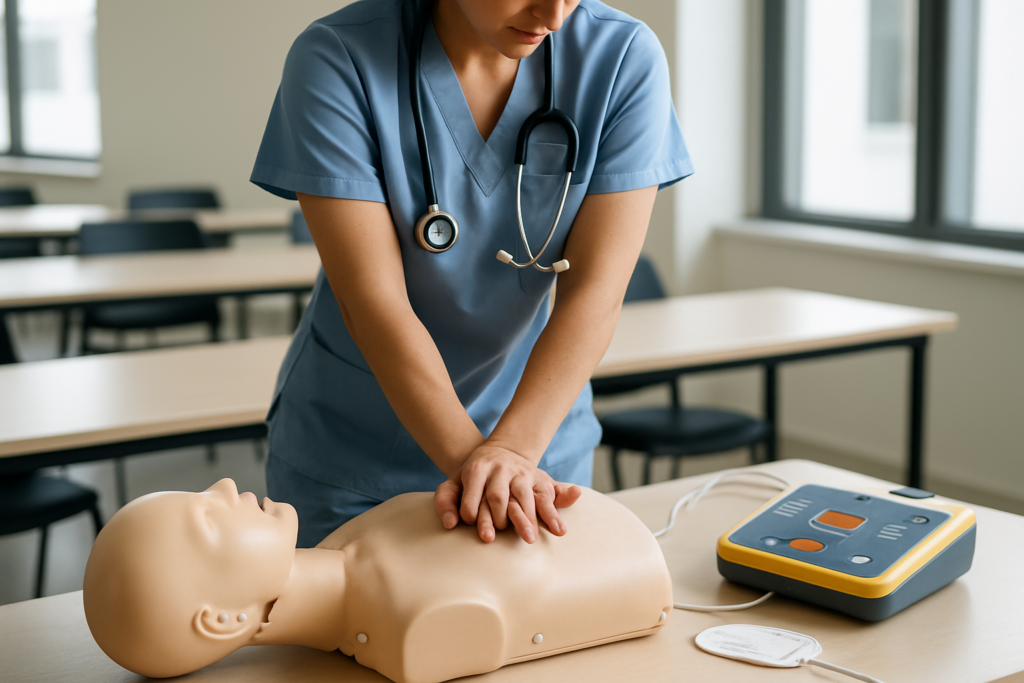
A BLS course teaches you high-quality CPR for adults, children, and infants, how to use an automated external defibrillator (AED), and how to relieve choking. That’s it — focused, practical, and deliberately accessible. No prior medical knowledge is required. A first-year nursing student and a 15-year ICU veteran sit the same BLS course.
The course typically runs four to five hours for the initial certification. Your AHA BLS card is valid for two years from the date you complete it.
If you’re working in any clinical role in Kuwait right now — ward nurse, outpatient clinic, day surgery — there’s a reasonable chance your employer already requires this. What matters for your migration plans is that the certificate is AHA-accredited, because that’s what overseas licensing bodies and employers want to see.
ACLS stands for Advanced Cardiovascular Life Support. Where BLS gives you the individual skills to keep someone alive in the first minutes of an emergency, ACLS takes you into the full clinical picture.
An ACLS course covers advanced airway management, IV access, cardiac pharmacology, 12-lead ECG interpretation, electrical therapies including defibrillation and cardioversion, and the management of cardiac arrest, stroke, and other acute cardiovascular emergencies. It also trains you in team dynamics and clinical leadership during high-pressure resuscitation scenarios — because in an ER or ICU, nobody works alone.
The AHA released updated ACLS course content in 2025, reflecting the latest science from the AHA Guidelines Update for CPR and Emergency Cardiovascular Care (ECC). If you completed ACLS before 2025, your card may still be valid, but the course content has changed — something worth knowing before your next renewal.
ACLS expects you to arrive already comfortable with ECG basics and ACLS pharmacology. That’s why BLS isn’t just a bureaucratic prerequisite — it genuinely builds the floor ACLS stands on.

This is one of the most common questions we hear, and the answer is unambiguous: you cannot enrol in an AHA ACLS course without a valid BLS certificate. It’s a hard requirement, not a suggestion.
For nurses planning a move abroad, this sequencing also has a practical timeline dimension. If you’re aiming to submit your nursing registration application to a Canadian provincial college, the UK NMC, or AHPRA in Australia within the next six to twelve months, you need to plan backwards from your target submission date.
A realistic schedule looks something like this. You sit BLS first — one day, done. Then you spend a few weeks brushing up on ECG interpretation and pharmacology. Then you sit ACLS. Both certifications are in hand, both valid for two years, and both ready to attach to your registration file alongside your Prometric or MOH exam results.
Missing this sequence — booking ACLS before you have a current BLS card, or letting your BLS lapse before renewal — means rebooking, repaying, and potentially delaying your application. It’s an avoidable frustration.
This is where things get genuinely practical, and it’s a question almost nobody in Kuwait is answering clearly online. So let’s be specific.
Canada: Most provincial nursing colleges, including the CRNBC in British Columbia and the CNO in Ontario, do not list BLS as a mandatory registration requirement. However, virtually every Canadian hospital that sponsors or hires internationally trained nurses requires current BLS (and often ACLS for ICU/ER roles) as a condition of employment. In practice, you will need it before your first shift. Nurses applying for critical care, emergency, or perioperative positions should expect ACLS to be on the job posting.
United Kingdom: The NMC registration process itself does not mandate BLS. But NHS Trusts and private hospitals require Basic Life Support as part of mandatory induction training for all clinical staff. If you want to arrive job-ready and avoid a delay between your registration being granted and your first employment contract, having a current AHA BLS card is a genuine advantage — and some employers specifically request AHA-format certification.
Australia: AHPRA’s nursing registration pathway doesn’t list BLS by name, but the standard of practice requires all registered nurses to maintain competency in emergency response. Most Australian hospitals, particularly in Queensland and NSW where Gulf-trained nurses frequently apply, require BLS as a hiring baseline. ICU and ED roles routinely ask for ACLS.
The short version: BLS is non-negotiable wherever you’re going. ACLS is required or strongly expected for any advanced clinical role. If you’re already working in an ICU or ER here in Kuwait, you should have both before you apply.
The Prometric licensing exam and the Kuwait MOH licensing process assess your clinical knowledge — they don’t require you to hold a current BLS or ACLS card to sit the exam itself. So no, you won’t be turned away at the exam centre.
That said, your BLS and ACLS certifications belong on your CV and in your registration file, not as afterthoughts but as credentials that demonstrate active clinical competency. Licensing assessors in Canada and Australia in particular look at the whole picture. A nurse who arrives with a completed Prometric score, a valid AHA BLS card, and an ACLS certificate looks significantly more prepared than one who is still sorting out certifications after the fact.
Get the certs while you’re still in Kuwait, before the exam cycle gets busy. You’ll thank yourself later.
Honestly? BLS is straightforward. The skills are hands-on and the pass rate is high when candidates come prepared. Most nurses complete it in a single day and leave feeling confident.
ACLS is meaningfully more demanding. You need to integrate pharmacology, rhythm recognition, and clinical decision-making under pressure, often in simulated scenarios with a team. Nurses who go in without brushing up on ECG interpretation sometimes find the first day difficult. That’s not a reason to avoid it — it’s a reason to prepare for it properly. The 2025 AHA update also introduced some content refinements, so using current study materials matters.
Roughly speaking, initial BLS takes about four to five hours. Initial ACLS typically runs across two days.
If you work with infants or children — in a NICU, paediatric ward, or paediatric ICU — there’s a third certification worth knowing about: PALS, or Paediatric Advanced Life Support. PALS is a parallel advanced course to ACLS, but it focuses entirely on the assessment and management of critically ill infants and children.
PALS does not replace ACLS. They sit alongside each other. If your target role abroad involves paediatric critical care, you’ll want to ask about PALS requirements at the same time as you plan your BLS and ACLS timeline.
Not all BLS and ACLS certificates are equal in the eyes of overseas employers and licensing bodies. The AHA format is the most widely recognised internationally. ASHI (the American Safety and Health Institute) also offers life support courses, but when destination countries or specific hospitals specify a provider, they almost always name AHA. If you’re investing time and money into these certifications as part of a migration plan, AHA is the straightforward choice.
REG Immigration and Education runs in-person, AHA-accredited BLS and ACLS courses here in Kuwait. That means you can complete both certifications before you board the plane — with the correct cards, the correct format, and no uncertainty about whether they’ll be accepted when you arrive. For nurses already working in hospitals across Kuwait, the convenience of doing this locally, with instructors who understand the Gulf healthcare context and the overseas migration process, is genuinely useful.
If you’re planning to submit a registration application in the next six to twelve months, now is a good time to sort both certifications. Get in touch with us and we’ll help you fit the courses into your existing schedule.
Q: What is the difference between BLS and ACLS?
BLS (Basic Life Support) covers CPR, AED use, and choking relief for all ages — it’s the baseline for any clinical role. ACLS (Advanced Cardiovascular Life Support) builds on BLS by adding ECG interpretation, advanced airway management, cardiac pharmacology, and team leadership for managing cardiac arrest and acute cardiovascular emergencies.
Q: Do I need BLS before I can take ACLS?
Yes. A valid AHA BLS card is a hard prerequisite for ACLS enrolment. You cannot register for an AHA ACLS course without it.
Q: Can I take ACLS without BLS?
No. The AHA requires candidates to hold a current BLS certification before sitting ACLS. There are no exceptions to this rule.
Q: How long does BLS or ACLS certification last?
Both AHA BLS and AHA ACLS cards are valid for two years from the date of completion. After two years, you need to complete a renewal course.
Q: Which certification do I need as a nurse — BLS or ACLS?
Every nurse in a clinical role needs BLS. If you work or plan to work in an ICU, ER, critical care, or surgical setting, you will also need ACLS. For paediatric critical care roles, PALS is additionally required.
Q: Is BLS or ACLS required for nursing registration in Canada, the UK, or Australia?
Registration bodies themselves (CNO, NMC, AHPRA) don’t mandate BLS as a registration condition, but virtually all hospitals in those countries require current BLS — and ACLS for advanced roles — as a condition of employment. Having both before you arrive puts you ahead.
Q: Does the Prometric or MOH exam require BLS or ACLS?
No, you don’t need BLS or ACLS to sit the Prometric or MOH licensing exam. However, both certifications strengthen your CV and registration file and are expected by employers in your destination country.
Q: Which is harder, BLS or ACLS?
BLS is accessible and most candidates complete it comfortably in a day. ACLS is significantly more demanding — it requires ECG interpretation, pharmacology knowledge, and performance in simulated emergency scenarios, typically across two days.
Q: What does ACLS cover that BLS does not?
ACLS adds advanced airway management, IV access, cardiac and stroke pharmacology, ECG rhythm interpretation, defibrillation and cardioversion, and team leadership training for resuscitation scenarios. These skills go well beyond the individual CPR and AED competencies taught in BLS.
Q: Do I need both BLS and ACLS?
If you work in emergency, critical care, ICU, or surgical settings, yes — you need both. BLS alone is sufficient for general ward and outpatient nursing roles, but advanced clinical positions consistently require ACLS on top of BLS.
Q: What is the difference between AHA BLS and ASHI BLS?
Both are recognised life support certifications, but the AHA (American Heart Association) format is the most widely accepted internationally, particularly by licensing bodies and hospitals in Canada, the UK, and Australia. If you’re certifying for overseas migration purposes, AHA is the safer choice.
Q: Should I get ACLS or PALS — what is the difference?
ACLS focuses on adult cardiac and cardiovascular emergencies. PALS (Paediatric Advanced Life Support) focuses on critically ill infants and children. They are separate certifications. Paediatric nurses need PALS; most other advanced clinical nurses need ACLS. Some nurses in mixed settings will eventually need both.