

You already know where you want to go. Canada Express Entry. UK Skilled Worker. Australian PR. Maybe NMC registration so you can finally work as a nurse in the NHS. The question that keeps you up at night is not whether you can get there — it’s exactly what IELTS score you need, which test version you must sit, and how to fit eight to twelve weeks of serious preparation around a full-time job in Kuwait.
This guide answers all of that in plain language, in one place. No vague advice. No upselling. Just the actual roadmap.
This matters more than most people realise. Your destination — not just your dream country, but the specific visa category or professional registration body — determines which IELTS test version you sit, what band score you need in each skill, and whether a regular IELTS result will even be accepted at all.
Get this wrong and you could spend KWD 75–100 on a test that your immigration authority simply will not accept. So let’s be precise.
There are two main versions of the IELTS. The reading and writing papers are different between them. The listening and speaking tests are identical.
IELTS Academic is for university admission (undergraduate or postgraduate), and also for professional registration — including nursing bodies like NMC UK and AHPRA Australia.
IELTS General Training is for most skilled worker and permanent residence visa applications — including Canada Express Entry, UK Skilled Worker, and Australian subclass 189/190.
Here is a simple rule of thumb:
Some people need both, at different stages. A nurse moving to the UK needs Academic IELTS (or OET) for NMC registration and may later need a separate English test for their visa — though in practice the NMC score often satisfies UKVI requirements if taken as a UKVI-approved test. More on that below.
| Your Goal | Test Version | Minimum Overall Band | Notes |
|---|---|---|---|
| Canada Express Entry (Federal Skilled Worker) | General Training | Band 6.0 (CLB 7) — ideally 7.5+ | Higher CLB = more CRS points |
| UK Skilled Worker Visa | General Training (UKVI) | Band 6.0–6.5 depending on role | Must be UKVI-approved |
| Australia PR (subclass 189/190) | General Training | Band 6.0–7.0 depending on occupation | |
| NMC UK nursing registration | Academic (UKVI) | Band 7.0 in each skill | No skill below 7.0 accepted |
| AHPRA Australia nursing registration | Academic | Band 7.0 overall, 7.0 in each skill | |
| Canadian nursing registration (CARNA, CNO, etc.) | General Training or Academic | Band 6.5–7.0 | Varies by province |
| UK university postgrad | Academic | 6.5–7.0 overall |
Band requirements correct as of 2025 — always verify with the issuing authority before you book your test.
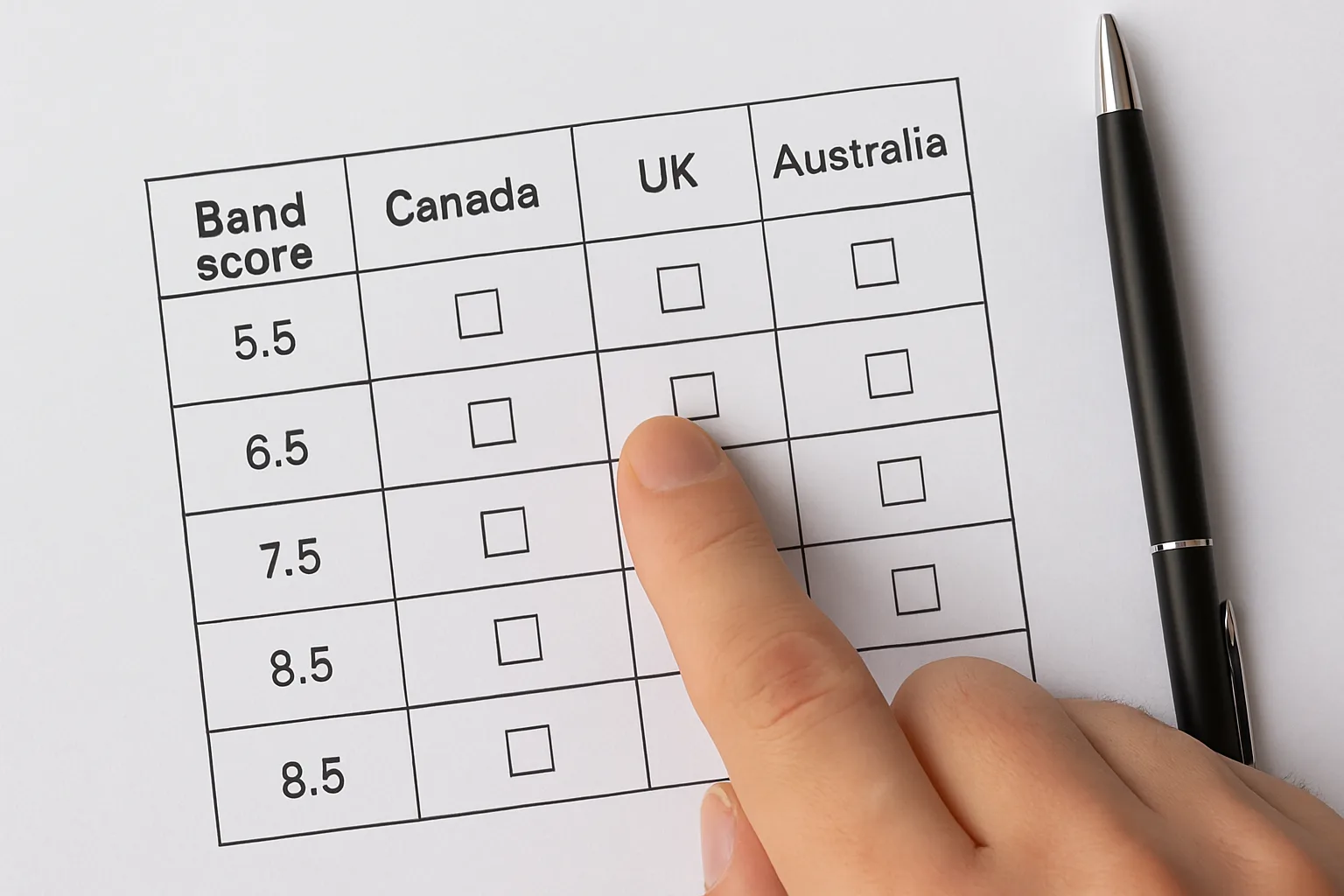
This trips people up constantly, so let’s be clear.
If you are applying for a UK visa — Skilled Worker, family reunion, Indefinite Leave to Remain — you cannot sit a standard IELTS and submit that score to the Home Office. You must take an IELTS test that is specifically approved by UK Visas and Immigration (UKVI). The test content is the same as regular IELTS, but it must be sat at an approved UKVI test centre and the result is reported directly to UKVI systems.
In Kuwait, UKVI-approved IELTS is available through IDP and British Council test venues including locations in Salmiya, Sharq, Sabah Al Salem, and Abu Halifa. British Council operates eight computer-delivered test locations across Kuwait.
For nurses applying to NMC UK: you specifically need the IELTS Academic for UKVI. Not Academic alone. Not UKVI General. The Academic for UKVI version. REG coaches this exact version, and we’ll make sure you book the right one from the start — because sitting the wrong version is an expensive mistake.
Canada uses the Canadian Language Benchmark (CLB) system. Your IELTS scores convert to CLB levels, and your CLB level feeds directly into your Comprehensive Ranking System (CRS) score.
| IELTS Band (each skill) | CLB Level | Approximate CRS Impact |
|---|---|---|
| 6.0 | CLB 7 | Baseline — qualifies, lower points |
| 6.5 | CLB 8 | Moderate points gain |
| 7.0–7.5 | CLB 9 | Significant CRS boost |
| 8.0+ | CLB 10+ | Maximum language points |
Moving from CLB 7 to CLB 9 across all four skills can add more than 50 points to your CRS score. At current draw levels, that difference can literally determine whether you receive an Invitation to Apply. This is not a small thing. Spending an extra four weeks on Writing before you sit the test could be worth more than years of additional Canadian work experience in your CRS calculation.
Most UK Skilled Worker roles require at least B1 level English (roughly Band 5.5–6.0). Some healthcare and regulated roles require B2 or higher. Check the specific Standard Occupational Classification (SOC) code for your job — requirements vary.
The NMC UK requires a minimum of Band 7.0 in each of the four skills — Listening, Reading, Writing, and Speaking. Not just the overall. If you score 8.0, 8.0, 8.0, and 6.5 in Speaking, you fail the NMC requirement. All four must be 7.0 or above.
AHPRA Australia has the same requirement: 7.0 in each skill, with an overall of at least 7.0.
This is why nurses face a tougher preparation challenge than most visa applicants. The margin for error is zero on any single skill.
If you are a nurse working in Kuwait and planning to register abroad, you face something unique: you need to satisfy two systems at the same time.
First, your English test score must meet the registration body’s requirements (NMC, AHPRA, CARNA, etc.). Second, if you are applying for a UK or Australian visa as part of the same process, your test may also need to be in the UKVI-approved format.
The good news: nurses internationally score notably higher than the general test population. Research from IELTS.org shows that 26% of nurses achieve Band 7, compared to just 9% of university-entry candidates. You have a real advantage — clinical English, medical vocabulary, and professional communication are already part of your daily life.
The common sticking point is Writing. The global average Writing score is around 5.9, the lowest of all four skills, and NMC requires 7.0. That gap is bridgeable — but it does not close by itself. Structured feedback on your Task 2 essays, in particular, is what moves the needle.
OET (Occupational English Test) is accepted by NMC UK and AHPRA Australia as an alternative to IELTS. It uses healthcare scenarios — ward handovers, discharge letters, patient consultations — which many nurses find more natural.
IELTS is accepted by more organisations worldwide (over 11,500 as of 2024) and is typically required for Canadian provincial nursing registration. OET is not universally recognised for visa purposes.
Our honest view: if your destination is the UK or Australia only and you are a nurse, OET is worth considering. If you want to keep your options open across multiple countries, or if you also need the score for a visa application, IELTS is the more versatile choice. We coach both, and we will help you decide based on your specific registration pathway — not just what is easier to prep for.
Most people working full-time in Kuwait need eight to twelve weeks of structured preparation to hit their target band. Eight weeks if you have a strong English foundation and a clear gap in one or two skills. Twelve weeks if you are starting from below your target by more than one band.
Here is what a realistic schedule looks like when you are working shift patterns or long clinical hours:
Weeks 1–2: Diagnosis and foundation
Sit a full practice test under timed conditions. Identify your actual weak skills — not the ones you assume are weak. Many people discover their Reading is slower than they thought, or that their Speaking fluency drops significantly under pressure.
Weeks 3–6: Skill-specific drilling
Focus on your weakest two skills. For most Kuwait-based expats, this is Writing and Speaking. Writing because the task types (Academic Task 1 graphs, Task 2 essays, or General Training letters) are unfamiliar. Speaking because fluency fades when you are tired after a twelve-hour shift.
Weeks 7–10: Full practice tests and timed conditions
Sit two full tests per week. Review every answer you get wrong — not just what was wrong, but why. This is where most self-studiers give up, because the feedback loop is absent.
Weeks 11–12: Refinement and confidence
Focus on test-day strategy. Timing in Reading. Word count discipline in Writing. Pacing in Speaking. Small adjustments here can move you half a band.
REG’s IELTS preparation course in Kuwait is built around this structure, with classes timed to work around common shift patterns and prayer times. We know you are not a full-time student. The schedule reflects that.

Writing is the lowest-scoring section globally. The worldwide average is approximately 5.9 (IELTS.org performance data, 2023). Fewer than 1% of candidates worldwide score Band 9 in Writing. This is not because Writing is impossibly hard — it is because most people practise the wrong things.
Here is what actually helps:
Understand the marking criteria. IELTS Writing is marked on four criteria: Task Achievement (or Task Response in Academic), Coherence and Cohesion, Lexical Resource, and Grammatical Range and Accuracy. Each counts for 25% of your Writing score. Most self-studiers focus entirely on grammar and ignore Task Achievement, which is often the bigger drag.
Write to a real word count. Academic Task 2 requires at least 250 words. General Training Task 1 letters require at least 150. Going under loses marks immediately. Going far over wastes time you need for Task 1.
Get your writing marked by a human. AI checkers and grammar tools do not grade IELTS criteria. You need someone who actually knows the band descriptors to read your essay and tell you precisely why it is a 6.0 and not a 7.0. That specific feedback is what moves you up.
Stop memorising template phrases. Examiners see the same memorised openers thousands of times. Authentic, varied language — even if occasionally imperfect — scores better than polished but robotic templates.
In our IELTS coaching sessions in Kuwait, Writing gets the most attention. Because it consistently costs people the band they need.
This is new, and it matters.
Since 2024, computer-delivered IELTS offers a One Skill Retake (OSR) option. If you pass three skills but fall short on one — typically Writing or Speaking — you can retake just that single section within 60 days of your original test date, rather than sitting the full four-hour exam again.
The OSR is only available for computer-delivered IELTS (not paper-based), and it must be booked within a set window after your results. The fee is lower than a full retake. Your new score for that one skill replaces your original score, and the other three skills remain as they were.
For nurses who need Band 7.0 in all four skills, this is genuinely useful. If your Writing comes back at 6.5 while your other three are already at 7.0 or above, you target Writing only. No need to risk your Speaking score by sitting the full test again.
REG helps you plan your retake strategy from the start — so if you do need an OSR, you are not scrambling to figure it out under pressure.
Our IELTS preparation course in Kuwait covers all four skills across eight to twelve weeks, with small group and one-to-one options available. Here is what you actually get:
IELTS scores are valid for two years from your test date. We help you time your test so your result is still valid when your visa application or registration is complete.
If you know your destination country and visa category — or even if you are still deciding — contact REG and tell us where you are trying to go. We will tell you exactly which test you need, what score you are aiming for, and whether our current IELTS preparation course cohort fits your timeline.
No pressure. Just a straight answer.
Academic is for university admission and professional registration (e.g., nursing bodies). General Training is for most skilled worker and permanent residence visa applications. The Listening and Speaking tests are the same; Reading and Writing differ between the two versions.
Canada uses CLB levels converted from your IELTS scores. CLB 7 (roughly Band 6.0 per skill) is the minimum for Federal Skilled Worker. Scoring CLB 9 (Band 7.0–7.5) across all four skills can add 50+ points to your CRS score — potentially the difference between receiving an Invitation to Apply or not.
The UK Home Office requires an IELTS test taken at a UKVI-approved centre, reported directly to UKVI systems. The content is the same as standard IELTS, but you must book the UKVI version. In Kuwait, UKVI-approved tests are available through IDP and British Council venues including Salmiya, Sharq, Sabah Al Salem, and Abu Halifa.
NMC UK requires a minimum of Band 7.0 in each of the four skills — Listening, Reading, Writing, and Speaking — using IELTS Academic for UKVI. A high overall average does not compensate for any skill below 7.0.
OET uses healthcare-specific scenarios and is accepted by NMC UK and AHPRA Australia. IELTS is accepted by more organisations globally (11,500+) and is required for most Canadian provincial nursing registration. If you are targeting multiple countries or also need a visa score, IELTS is more versatile. If your destination is the UK or Australia only, OET is worth considering.
Yes. Since 2024, computer-delivered IELTS offers a One Skill Retake (OSR). If you pass three skills but fall short on one, you can retake that section within 60 days of your original test date. The OSR is only available for the computer-delivered format and must be booked within a specific window after your results.
Eight to twelve weeks of structured preparation is realistic for most working professionals. Eight weeks if you have a strong English base; twelve weeks if you are more than one band below your target. REG’s IELTS course is structured around shift-worker schedules, including nurses working long clinical hours.
Band 6.0 per skill = CLB 7. Band 6.5 = CLB 8. Band 7.0–7.5 = CLB 9. Band 8.0+ = CLB 10+. Each CLB level up translates into more CRS points, with the jump from CLB 7 to CLB 9 being particularly significant — potentially adding over 50 CRS points.
There is no official limit on the number of IELTS attempts. You can retake the test as soon as a new sitting is available. IELTS scores are valid for two years from the test date, so timing your test to align with your visa or registration timeline matters.
Yes. IELTS is accepted by over 11,500 organisations worldwide, including universities and employers in Kuwait and across the GCC. Many private universities in Kuwait require Band 5.5–6.5 for undergraduate entry; competitive postgraduate programmes often require 7.0 or above.