

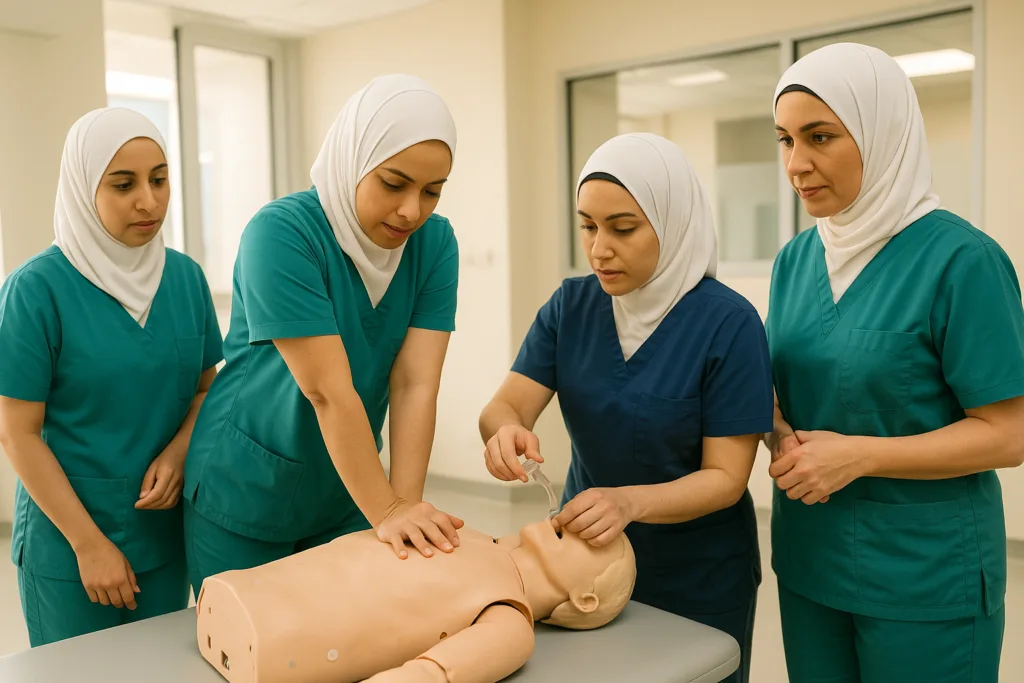
If you’re a nurse working in Kuwait and someone has mentioned ACLS — whether your hospital HR team, your MOH renewal paperwork, or a recruiter from Canada — here’s the short answer: Advanced Cardiac Life Support (ACLS) certification is required for Kuwait MOH licence renewal, and that same certificate carries real weight when you apply for nursing roles in Canada, the UK, Australia, or New Zealand. One course. Two problems solved.
Let’s walk through everything you actually need to know.
BLS (Basic Life Support) teaches you the fundamentals: CPR, rescue breathing, using an AED. You probably already have it. ACLS builds directly on that foundation.
Where BLS is first-response, ACLS is what happens next. It covers team-based resuscitation, advanced airway management, cardiac pharmacology (the drugs — when, why, how much), interpreting rhythms, and post-cardiac-arrest care. The American Heart Association (AHA) describes ACLS as emphasising team dynamics, systems of care, and communication just as much as the clinical skills themselves. That matters, because real resuscitations are team events, not solo performances.
So no — you don’t need to choose between BLS and ACLS. You need BLS first, then ACLS. Think of it as Level 1 and Level 2 of the same skill set.
Do you need to complete BLS before ACLS? Yes. BLS is a prerequisite for ACLS with both AHA and ASHI (the two main certifying bodies). If your BLS card has lapsed, sort that out first — it’s a one-day course and we run those too.
Yes, and this surprises some nurses who assumed ACLS was optional or only for ICU staff.
Kuwait’s Ministry of Health requires ACLS certification for granting and renewing professional licences for healthcare professionals — nurses and doctors included. If your licence renewal is coming up and your ACLS certificate is expired or missing, that renewal stalls. Full stop.
The practical implication: don’t leave this to the last minute. Certification takes one to two days depending on the course format, and you need a valid card in hand before you submit your renewal documents.
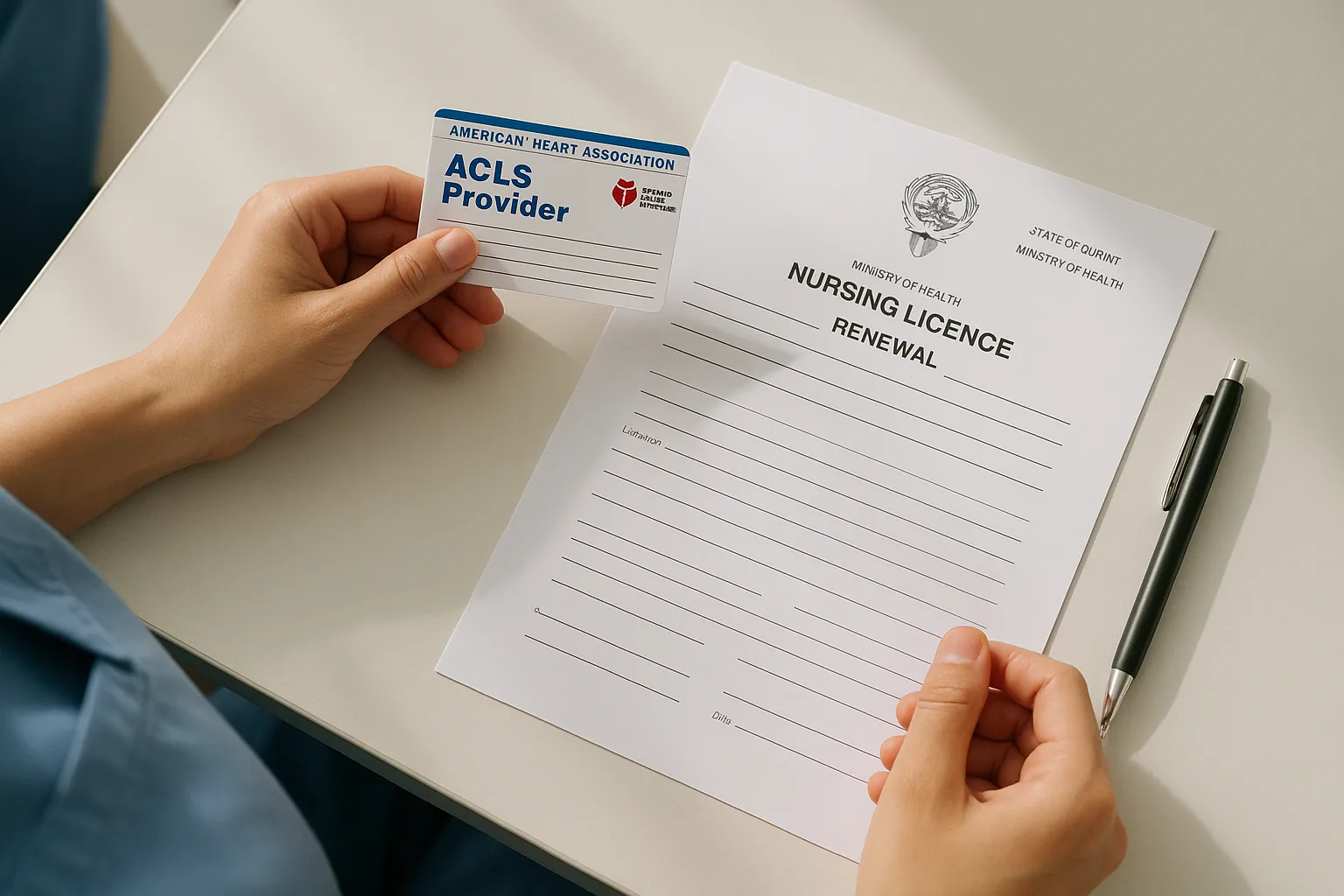
This is one of the most common questions we hear, and almost nobody else explains it clearly, so let’s fix that.
AHA (American Heart Association) ACLS is the gold standard globally. It’s the certification specifically named by licensing bodies in most migration destinations:
ASHI (Award for Safety and Health Institute) ACLS is a recognised alternative. Kuwait MOH accepts it for licence purposes. The written exam threshold is slightly lower — 75% correct versus AHA’s 84% — which some nurses find reassuring. It’s a legitimate certification. But if you are planning to migrate, AHA ACLS will open more doors internationally, because it’s the name employers in Canada, the UK, and Australia recognise without needing to verify further.
Our honest advice: if you’re staying in Kuwait long-term, ASHI is fine. If you have any intention of working abroad in the next few years — and many nurses we work with do — get AHA. You’ll avoid the hassle of explaining what ASHI is to a credentialling coordinator in Toronto or Brisbane.
The AHA ACLS course runs between 8 and 16 hours depending on the format. Here’s what fills those hours:
You’ll also sit a written exam. AHA requires 84% to pass; ASHI requires 75%. Skills stations are assessed separately and must be completed successfully alongside the written component.
If studying independently suits you better, AHA also offers HeartCode ACLS — a blended format where Part 1 is self-directed online learning, and Part 2 is an in-person skills check-off with a certified instructor. We offer this format too.
Nobody talks about this part, and it’s genuinely useful to know before you show up.
Bring:
– Your current, valid BLS card (required — no exceptions)
– Photo ID (civil ID or passport)
– Comfortable clothes you can move in — you will be on the floor doing compressions
– A pen and a small notebook if you like to annotate
– Water and a snack; the day is long and energy dips
What to expect:
The day starts with a brief orientation, then moves into case-based learning — short scenarios that introduce concepts before you practise them on manikins. You’re not just sitting in a lecture. There’s a lot of hands-on time: airway practice, rhythm drills, team scenarios.
The Megacode comes near the end. It feels daunting if you haven’t done one before, but our instructors walk you through the structure beforehand. You know what’s being assessed. The goal is competence, not catching you out.
Results are typically confirmed on the day. If you pass (and the overwhelming majority of prepared candidates do), your certification card is issued promptly.
ACLS certification is valid for 2 years from the month of issue. After that, you’ll need an ACLS renewal course — shorter than the initial course, but still required.
Here’s the real-world problem nobody else mentions: visa processing takes time. Sometimes a lot of time. If your Kuwait ACLS card was issued 18 months ago and you’re waiting on a work permit for Canada or Australia, you may be cutting it very close — or you may arrive at your credentialling interview with an expired certificate.
The solution is straightforward but requires planning. Book your ACLS renewal before your card expires, not after. An expired card cannot be ‘reactivated’ — you sit the renewal course while it’s still current, and your new 2-year clock starts from there.
If you’re currently mid-visa-application and worried about timing, come and talk to us. We’ll look at your dates and tell you honestly whether you need to renew now or whether you have room to wait.
Most training providers in Kuwait focus their marketing — and sometimes their physical locations — on Salmiya and the central Ahmadi strip. If you’re based in Mangaf, Jaleeb Al-Shuyoukh, or anywhere along the southern healthcare corridor, that’s a real inconvenience.
REG is accessible to nurses across Kuwait, including those working in the south. If you’re unsure about location or scheduling, get in touch directly and we’ll sort out the details with you.
Here’s what’s different about doing your ACLS training with us.
REG works directly with hospitals, healthcare companies, and recruitment firms across Kuwait. Our instructors understand not just the clinical content but the context — the MOH renewal requirements, the credentialling checklists that Canadian and Australian employers send, the questions that come up when you’re preparing your overseas nursing application.
When you complete ACLS with REG, you’ll gain more than a certificate. You’ll understand why the content matters, how it connects to your licence renewal right now, and how to present that certification confidently when a recruiter in Auckland or an HR team in Calgary asks about your emergency response training.
You’re not just ticking a box. You’re building a record that follows you across borders.
Join the nurses who’ve already taken this step with us — and if you have questions about timing, format, or what your specific destination country will want to see, reach out. We’re here to help you work it out.
BLS (Basic Life Support) covers CPR and AED use. ACLS (Advanced Cardiac Life Support) builds on BLS with advanced airway management, cardiac pharmacology, rhythm interpretation, and team-led resuscitation. BLS is a prerequisite for ACLS.
ACLS is recommended for ER nurses, ICU nurses, cardiac care unit nurses, paramedics, emergency physicians, anaesthesiologists, and cardiologists. Kuwait MOH requires it for licence granting and renewal across healthcare professionals.
Yes. Kuwait’s Ministry of Health requires valid ACLS certification as part of the professional licence renewal process for nurses and doctors.
Both are accepted by Kuwait MOH. For international migration (Canada, UK, Australia, New Zealand), AHA ACLS is more widely recognised by name among hospital credentialling teams and is the safer choice if you plan to work abroad.
Yes. A current, valid BLS card is a prerequisite for both AHA and ASHI ACLS courses.
The AHA ACLS course runs 8 to 16 hours depending on the format. HeartCode ACLS (blended learning) splits this into online self-study plus an in-person skills check-off.
AHA ACLS requires 84% on the written exam plus successful completion of the Megacode and skills stations. ASHI ACLS requires 75% on the written exam.
ACLS certification is valid for 2 years from the month of issue. Renewal must be completed before the card expires.
An expired certificate cannot be reactivated. Book your ACLS renewal before your current card expires to avoid a gap. If you’re in the middle of visa processing, plan your renewal timing carefully — we can help you work out the dates.
Yes, if it’s AHA-issued. AHA ACLS is internationally recognised. Employers in Canada, Australia, the UK, and New Zealand are familiar with AHA certification and accept it during the credentialling process.
REG serves nurses across Kuwait, including those in the southern corridor. Contact us directly to discuss scheduling and location options.
Bring your valid BLS card, photo ID, comfortable clothing you can move in, and water. Your BLS card is mandatory — you won’t be able to participate without it.