
If you’re a nurse or healthcare professional working in Kuwait, BLS certification isn’t optional — it’s a Kuwait Ministry of Health (MOH) requirement to obtain or renew your clinical licence. A valid BLS card is also the first credential most destination countries check when you apply for nursing roles in Canada, the UK, Australia, or New Zealand.
This post answers every question we hear from nurses at our branches, in plain English, with no fluff.
Yes. The Kuwait MOH requires healthcare professionals — nurses, doctors, paramedics, and allied health staff — to hold a current BLS certification as a condition of licence issuance and renewal. This isn’t a hospital policy that varies by employer; it’s a regulatory requirement. If your card lapses, your licence renewal application will stall.
BLS certificates are valid for two years from the date of issue. Mark that date. We’ve seen nurses miss licence renewals simply because they assumed their card was still current.
Not quite, and the difference matters.
A basic CPR certificate (sometimes sold as a CPR/First Aid course) is designed for the general public — bystanders, office workers, parents. It covers adult chest compressions and rescue breathing.
BLS — Basic Life Support — is designed specifically for healthcare professionals who may need these skills on the job, under clinical conditions. An AHA BLS Provider course, for example, teaches CPR for adults, children, and infants, correct AED (automated defibrillator) use, relief of choking, and two-rescuer team techniques. It’s broader, more rigorous, and the standard that hospitals and the Kuwait MOH actually require.
So no — a CPR certificate does not substitute for BLS when your licence is on the line.
This is the question nobody else seems to answer clearly, so let’s be direct about it.
AHA (American Heart Association) is the most widely recognised BLS provider globally and is accepted by Kuwaiti hospitals, the MOH, and virtually every overseas licensing body (NCLEX boards, NMC in the UK, AHPRA in Australia, NZMC in New Zealand). If you’re planning to migrate, AHA is the safest choice.
ASHI (American Safety and Health Institute), now operating under the Health & Safety Institute (HSI), issues BLS certifications that are accepted in Kuwait’s private hospital sector and by many international employers. It’s a legitimate, widely recognised credential.
American Red Cross BLS is also valid in most contexts, though international portability varies slightly by destination country.
Our honest take: if you’re a nurse with any intention of working abroad within the next few years, do your BLS through an AHA-authorised training centre. It removes any acceptance question before it starts.
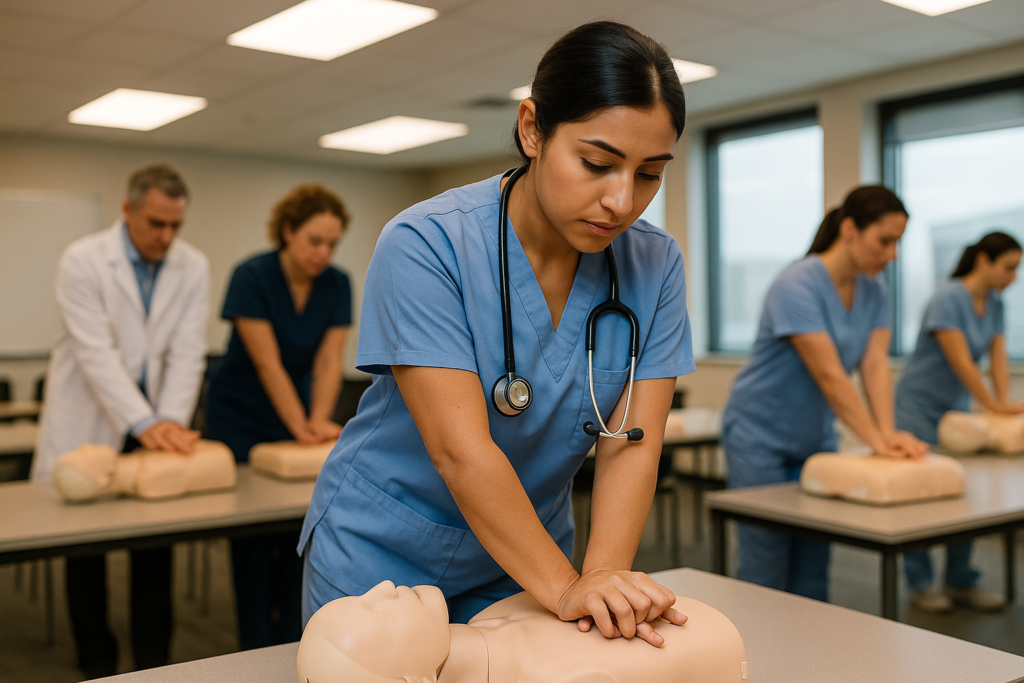
A standard instructor-led AHA BLS Provider course runs approximately 4–5 hours from start to finish. That includes the video-based instruction, hands-on skills practice with manikins, and the written assessment.
Blended learning options are also available: you complete 1–2 hours of online pre-work at home, then attend a 2–3 hour in-person skills session at the training centre. For shift workers, this split format is genuinely useful — you can do the theory portion on your phone during a quiet break.
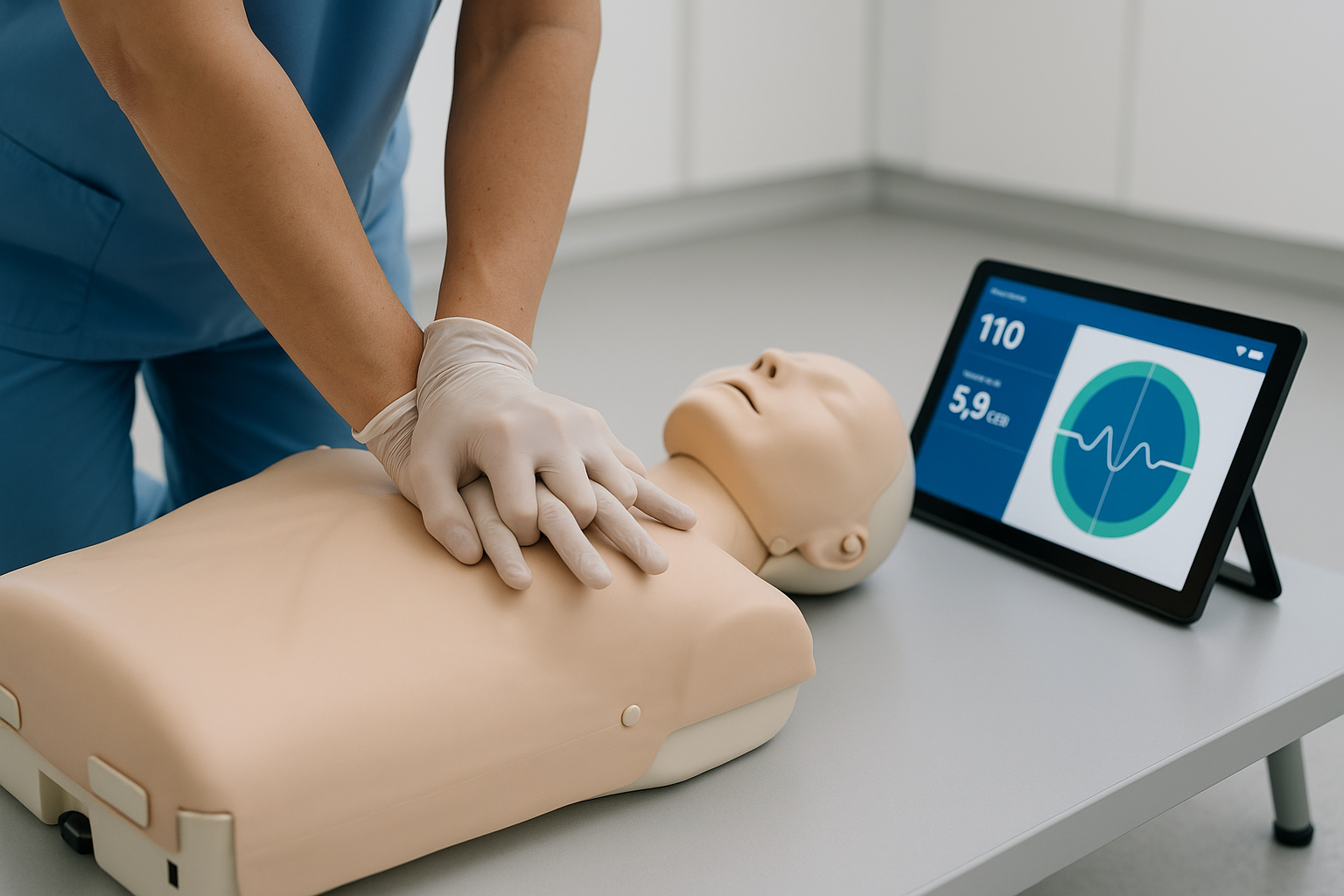
Modern BLS training now uses real-time feedback technology — tablet-connected manikins that measure your compression depth and rate as you practice. It sounds high-tech, but in practice it just means you leave knowing your technique is actually correct, not guessing.
We know juggling 12-hour shifts, rest days, and study prep is genuinely exhausting. The last thing you need is a training schedule that treats you like you work a 9-to-5.
At REG, our three branches — in Salmiya, Jaleeb, and Mangaf/Fahaheel — offer BLS courses in evening and weekend batches specifically because most of our students are working nurses. You don’t have to take annual leave to get this done. Check current batch schedules with our team directly; availability changes week to week, and we’d rather give you accurate information than post a timetable online that’s already out of date.
Walk-in availability depends on seat capacity. For BLS specifically, we recommend booking at least a few days ahead — courses fill quickly when licence renewal season peaks.
This is a real anxiety, and it deserves a straight answer.
If your BLS certificate expires while your immigration file is being processed, you’ll need to renew it before your destination country’s licensing body will finalise your registration. For example, the UK’s Nursing and Midwifery Council (NMC) and Australia’s AHPRA both require a current, in-date BLS or equivalent CPR credential at the point of registration — not just at the point of application.
The practical fix: don’t let your card lapse. BLS recertification in Kuwait takes a single half-day. If you know your visa is likely to take 6–12 months, time your renewal so the new card covers the expected approval window with several months to spare.
At REG, when we’re helping a nurse build their immigration file, we flag BLS expiry dates as part of the file review. It’s one of those small things that can quietly derail a timeline if nobody’s watching it.
BLS is the foundation. Every nurse needs it.
ACLS (Advanced Cardiovascular Life Support) is the next level up — it adds pharmacological interventions, cardiac rhythm interpretation, and advanced airway management. ACLS is typically required for ICU, CCU, emergency, and critical care nurses, and it’s increasingly asked for by Canadian and Australian hospitals at the point of hire.
You cannot do ACLS without a current BLS card. Think of them as sequential, not interchangeable.
If you’re an ICU or ER nurse planning to migrate, you’ll likely need both. If you’re a general ward nurse, BLS alone satisfies most initial licensing requirements abroad.
This is where we want to be honest with you about what REG actually does, because it matters.
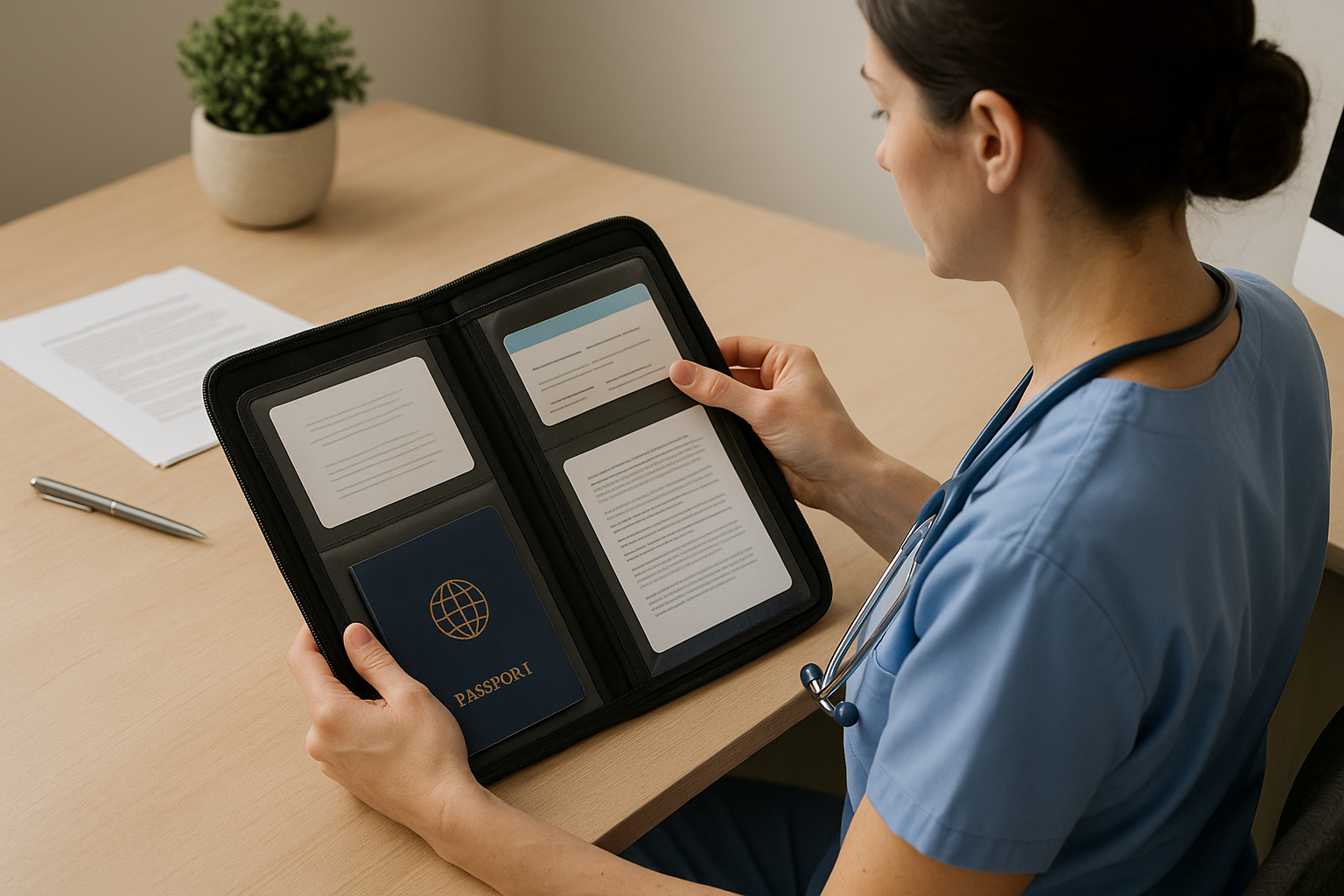
Most training centres sell you a BLS course and send you home. That’s fine if BLS is all you need. But if you’re a nurse in Kuwait with your eyes on Canada, the UK, Australia, or New Zealand, BLS is just the first stamp in a much larger passport.
Here’s the credential pathway we guide nurses through at REG:
We’re one of very few organisations in Kuwait that can support you at every single one of those stages, in-house, without handing you off to a third party for each step. That matters practically: your BLS instructor and your OET coach can actually talk to each other. Your immigration adviser sees your full credential picture, not just the piece they were asked about.
Nursing is competitive right now in every destination country. A complete, coherent, up-to-date portfolio lands jobs. A scattered one doesn’t.
BLS course fees in Kuwait vary by provider and whether you’re doing a full course or a renewal. For current REG pricing, get in touch with our team directly — fees update periodically and we want you to have the right number, not a figure that’s already changed.
What we will say: when you’re comparing costs, check whether the price includes your AHA course materials and digital certification card. Some centres quote a lower headline price and add these separately.
An AHA BLS Provider card issued by an authorised training centre in Kuwait is internationally valid. The AHA credential itself is recognised by the NMC (UK), AHPRA (Australia), NZMC (New Zealand), and the nursing regulatory bodies across Canadian provinces.
What matters is that the training centre issuing your card is an AHA-authorised training site — not just a centre that teaches AHA content. Ask for that confirmation before you book. At REG, we can confirm our authorisation status directly.
If you’re due for renewal, planning a licence application, or you’re a nurse thinking seriously about working abroad in the next year or two, your BLS card is the right place to start. It’s quick, it’s practical, and it opens every door that comes after it.
We’re at branches in Salmiya, Jaleeb, and Mangaf. Reach out to our team and we’ll tell you exactly when the next available batch is, what you need to bring, and how BLS fits into whatever you’re planning next. No pressure — just a straightforward conversation.
Is BLS certification mandatory for nurses in Kuwait?
Yes. The Kuwait MOH requires a valid BLS certificate for clinical licence issuance and renewal. It applies to nurses, doctors, paramedics, and allied health professionals.
How long is a BLS certificate valid in Kuwait?
Two years from the date of issue, in line with AHA guidelines. After that, you need a recertification course to maintain compliance.
What’s the difference between AHA BLS and ASHI BLS — which does Kuwait accept?
Both are accepted in Kuwait. AHA BLS is the most universally recognised internationally and is the safest choice if you plan to migrate. ASHI (HSI) is also widely accepted in Kuwait hospitals.
How long does a BLS course take?
A standard instructor-led course takes 4–5 hours. Blended options split into 1–2 hours of online pre-work and a 2–3 hour hands-on skills session.
What happens if my BLS card expires while my visa is being processed?
You’ll need to renew before overseas licensing bodies finalise your registration. Renew early enough that the new card covers your expected approval date with a buffer.
Do I need BLS to apply for nursing jobs in Canada, the UK, Australia, or New Zealand?
Yes. All four countries require a current BLS or equivalent CPR credential at the point of nursing registration. An AHA BLS card is accepted by all four.
What’s the difference between BLS and ACLS?
BLS is the foundation — required for all nurses. ACLS is an advanced course covering cardiac emergencies and is required for ICU, CCU, and emergency nurses. You need a current BLS card before you can do ACLS.
Can I do BLS and OET coaching at the same place in Kuwait?
At REG, yes. We support nurses through BLS, OET/IELTS, Prometric/NCLEX, and immigration file preparation — all in-house, across our three Kuwait branches.
Is a BLS certificate from Kuwait valid abroad?
An AHA BLS Provider card issued by an authorised training site in Kuwait is internationally valid and recognised by the NMC, AHPRA, NZMC, and Canadian provincial nursing bodies.