The Kuwait Expat & Healthcare Worker’s Complete Guide to Choosing and Passing an IELTS Preparation Course
We know how much is riding on this score. Whether you’re a nurse planning to register with the UK’s NMC, an engineer pursuing Canada Express Entry, or a Kuwait resident renewing a professional licence, the IELTS result sitting in your inbox in a few weeks can genuinely change the direction of your life. That’s not an exaggeration — and it’s exactly why choosing the right preparation course for IELTS exam matters as much as the exam itself.
This guide walks you through every practical decision: which IELTS type you actually need, what band score your destination country or registration body requires, how Kuwait’s exam venues work in 2025, and — for healthcare professionals especially — whether IELTS is even the right test for you.
IELTS Academic vs General Training: Which One Do You Need?
There are two main versions of IELTS, and picking the wrong one is a costly mistake.
IELTS Academic is for people applying to undergraduate or postgraduate programmes, and — critically — for professional registration with bodies like Australia’s AHPRA, the UK’s NMC, or New Zealand’s NCNZ. If you’re a nurse, doctor, or allied health professional seeking overseas registration, this is almost certainly your version.
IELTS General Training is for most immigration routes — Canada Express Entry, UK skilled worker visas, Australian General Skilled Migration, and New Zealand residence. It tests the same four skills (Listening, Reading, Writing, Speaking) but the Reading and Writing tasks are pitched at real-world, workplace scenarios rather than academic texts.
The Speaking and Listening sections are identical across both versions, which matters for your study plan.
If you’re unsure, the simplest rule: immigration usually means General Training; professional registration or university usually means Academic. Check the specific requirement of your visa subclass or registration body before you book anything.
What Band Score Do You Actually Need?
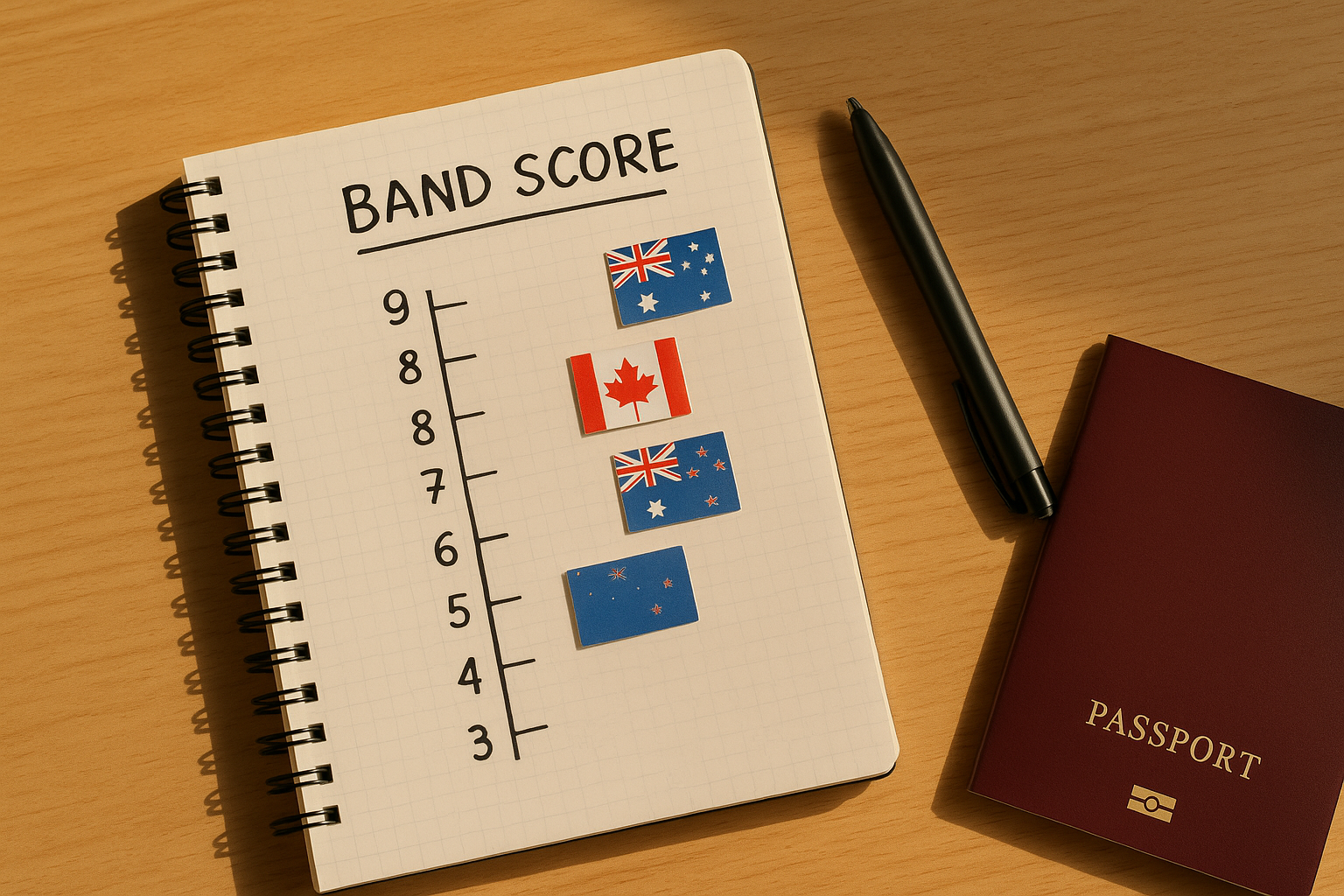
IELTS is scored on a 1–9 band scale. Your overall band is the average of your four section scores — Listening, Reading, Writing, Speaking — rounded to the nearest 0.5 (IELTS.org, 2025). A Band 7.0 overall, for example, doesn’t always mean you can afford a 6.0 in one skill; many programmes require minimum scores per section.
Here’s what the major destinations typically ask for in 2025:
Canada (Express Entry / Federal Skilled Worker)
CLB 9 (roughly IELTS 7.0 in each band for top points) is the target if you want competitive Comprehensive Ranking System scores. The minimum is CLB 7, which maps to around 6.0 per section — but a higher score directly lifts your CRS points.
United Kingdom (Skilled Worker Visa)
You need UKVI IELTS — not standard IELTS — for most UK visa applications. The typical minimum is B1 (Band 4.0) to B2 (Band 5.5) per skill depending on visa category, though many NHS employers and the NMC require Band 7.0 in each section. More on UKVI below.
Australia (General Skilled Migration)
Most skilled visa subclasses require IELTS 6.0 overall with no band below 6.0, but Competent English for AHPRA registration means 7.0 in each of the four sections — a meaningfully higher bar.
New Zealand (Skilled Migrant)
Immigration New Zealand accepts IELTS with a minimum of 5.0 per band for most categories, but NCNZ nursing registration requires 7.0 in Listening and Reading, and 6.5 in Writing and Speaking.
Write your target down. Then check the per-section minimums — that detail trips up more people than the overall band requirement does.
UKVI IELTS: What It Is and Why It Matters
UKVI IELTS (IELTS for UK Visas and Immigration) is a version of the standard IELTS test that is approved by the UK Home Office. The content and scoring are the same — you won’t face harder questions. The difference is that your results are sent through a secure channel the Home Office can verify directly.
If you’re applying for a UK Skilled Worker visa, a UK student visa, or UK settlement (ILR), you almost certainly need UKVI IELTS, not the standard version. Using a standard certificate when UKVI is required will mean a rejected application.
In Kuwait, UKVI IELTS is available through British Council Kuwait venues. If this is your route, make sure your IELTS coaching Kuwait provider understands the UKVI-specific requirements — not all preparation centres flag this distinction clearly.
IELTS for Nurses in Kuwait: Which Test Should You Actually Take?
This is probably the most important section on this page for healthcare workers, so read it carefully.
Nurses and allied health professionals planning to register in the UK or Australia have a genuine choice: IELTS Academic or OET (Occupational English Test). Both are accepted. Here’s the honest comparison.
OET is healthcare-specific. The reading passages, listening recordings, and writing tasks all involve clinical scenarios — patient histories, referral letters, medication instructions. If you spend your days in a clinical environment, this context can actually make OET easier to prepare for, even though the pass threshold looks high.
IELTS Academic is broader and tests general academic English. If your reading and writing in English already spans non-clinical topics, IELTS may suit you better.
For UK NMC registration, you need one of the following in IELTS Academic: 7.0 in each of the four sections. No exceptions. For AHPRA (Australia), it’s also 7.0 in each section. NCNZ (New Zealand) requires 7.0 in Listening and Reading, 6.5 in Writing and Speaking. NNAS (Canada) accepts IELTS General or Academic at the level your provincial nursing college specifies — often 6.5 to 7.0 per section.
If you’re sitting at Band 6.0–6.5 and struggling specifically with the Academic Writing task, OET might genuinely be your faster route to registration. If you’re already comfortable with general academic English, push through with IELTS.
At REG, we offer both IELTS coaching and OET coaching, which means we can look at your actual practice scores and give you an honest recommendation — not just push you toward whichever course we have a seat in.
How IELTS Works in Kuwait in 2025: Venues, Cost, and Delivery
All official IELTS test sessions at IDP Kuwait venues are now computer-delivered, with results available within 2–5 days (IDP IELTS Kuwait, 2025). British Council Kuwait offers computer-delivered IELTS across 8 locations, with results in approximately 48 hours.
The exam fee in Kuwait typically ranges from KWD 75 to KWD 100 depending on the test centre and test type (Dreamztree / Laimoon.com, 2025). UKVI IELTS tends to be at the higher end of that range.
Computer-delivered vs. paper-based: Paper-based IELTS is now rarely available in Kuwait. Computer delivery actually has practical advantages — you can type your Writing responses, which most test-takers find faster, and the interface highlights text as you listen in the Listening section. Practise on a computer during your preparation. Don’t show up having only ever handwritten practice essays.
The Speaking test is still face-to-face with a human examiner, regardless of venue or delivery mode.
The One Skill Retake (OSR): A Recent Change Worth Knowing
This is newer policy that relatively few test-takers in Kuwait have heard about yet.
If you took your IELTS on a computer and missed your target in just one section, you may be eligible for a One Skill Retake (OSR) — meaning you resit only that section rather than the full four-hour test (IDP IELTS Kuwait, 2025). This is only available for computer-delivered IELTS, and there are eligibility conditions, so confirm with your test centre before assuming you qualify.
For someone who scored 6.5 in Writing but 7.5 in everything else, the OSR is potentially a significant saving of time, stress, and money. It’s the kind of detail your preparation course for IELTS exam should be flagging for you — it’s not widely advertised.
A Realistic IELTS Study Timeline for Working Professionals in Kuwait
Here’s a practical roadmap. It assumes you’re working full-time and can commit around 1–1.5 hours on weekdays and 2–3 hours on weekends.
Starting at Band 5, targeting Band 7 (e.g., Canada Express Entry): Allow 10–12 weeks minimum.
Weeks 1–2: Diagnostic test. Identify your weakest section. Begin structured grammar and vocabulary work. Start listening to English podcasts daily — 20 minutes while commuting counts.
Weeks 3–4: Focused Reading practice. Work through Academic or General Training passages under timed conditions. Don’t read passively — annotate, summarise.
Weeks 5–6: Writing Task 1 and Task 2 (or GT letter and essay). Get written feedback on every practice essay. This is where a good IELTS coaching Kuwait course earns its fee — self-marking Writing is almost useless.
Weeks 7–8: Speaking practice. Record yourself. It’s uncomfortable. Do it anyway. The examiner is assessing fluency, coherence, vocabulary range, and pronunciation — not perfect grammar.
Weeks 9–10: Full timed mock tests under exam conditions. Review every error. Focus on your single weakest section.
Starting at Band 6.5, targeting Band 7.5 (e.g., AHPRA or NMC): Allow 6–8 weeks if you’re consistent.
These timelines assume genuine daily effort. Two hours a week won’t move your band score significantly. The honest truth is that a Band 5 to Band 7 improvement in under 8 weeks is achievable but unusual — factor in buffer time before your visa or registration deadline.
Score Expiry and Retake Strategy
IELTS scores are valid for two years from the test date (Official IELTS, 2025). If your visa process is taking longer than expected — and in Kuwait, it sometimes does — keep this in mind. Booking your exam too early can leave you with an expired certificate and the cost of a full retake.
If you’re planning a Canada Express Entry application and your process might stretch beyond 18 months from your test date, speak to an immigration adviser before you sit. Timing the exam strategically is part of a good immigration plan.
There is no limit on how many times you can retake IELTS. You can resit as soon as three days after your last attempt, though practically speaking, you need time to improve — not just to repeat the same mistakes on a different date.
Choosing the Right Preparation Course for IELTS Exam in Kuwait
There are at least 8 training centres in Kuwait offering IELTS preparation (Laimoon.com, 2025). Here’s what actually matters when you’re choosing:
Written feedback on Writing tasks. Not just a score — actual annotation explaining why you lost marks and what to change.
Awareness of your specific visa or registration requirement. A preparation centre that doesn’t ask which version of IELTS you need, or what band score your destination requires, isn’t thinking about your goal.
Flexibility for working schedules. Morning, evening, and weekend options matter when you’re working full-time in Kuwait.
UKVI and OET capability. If there’s any chance your goal involves the UK or a healthcare registration body, your provider should understand both pathways.
At REG Immigration and Education, our IELTS coaching is built around your specific goal — not a generic syllabus. We combine IELTS preparation, OET coaching, and immigration consultancy under one roof, which means we can tell you which test to take, prepare you for it, and then support your visa or registration application. That end-to-end view is genuinely rare.
You’ve put a lot of thought into your future. The preparation you do over the next few weeks should reflect that. Take it seriously, be consistent, and reach out when you need guidance — that’s what we’re here for.
FAQ
What is the difference between IELTS Academic and IELTS General Training?
IELTS Academic is required for professional registration (nursing, medicine) and university admission. IELTS General Training is used for most skilled migration routes to Canada, Australia, the UK, and New Zealand. Reading and Writing tasks differ between the two versions; Listening and Speaking are the same.
What IELTS band score do I need for Canada, the UK, Australia, or New Zealand?
For Canada Express Entry, CLB 9 (roughly 7.0 per section) maximises points; CLB 7 is the minimum. UK Skilled Worker visas require UKVI IELTS, typically B2 or higher per skill. Australian skilled migration generally requires 6.0 overall with no band below 6.0. New Zealand skilled migrant routes accept 5.0 per band for most categories, though professional registration bodies require more.
What is UKVI IELTS and is it different from standard IELTS?
UKVI IELTS has the same content and scoring as standard IELTS. The difference is that results are shared securely with the UK Home Office for visa processing. If you’re applying for a UK visa, you must use UKVI IELTS — a standard certificate won’t be accepted.
Should a nurse take IELTS or OET for UK or Australia registration?
Both IELTS Academic (7.0 in all four sections) and OET (Grade B in all four sub-tests) are accepted by NMC (UK) and AHPRA (Australia). OET uses clinical scenarios throughout, which some healthcare professionals find more familiar. If your general academic English is strong, IELTS may be faster. If you’re more comfortable in clinical language than academic writing, OET is worth considering.
What band scores do nurses need for AHPRA, NMC, NNAS, and NCNZ?
AHPRA (Australia): 7.0 in each of Listening, Reading, Writing, and Speaking. NMC (UK): 7.0 in each section. NCNZ (New Zealand): 7.0 in Listening and Reading; 6.5 in Writing and Speaking. NNAS (Canada): requirements vary by provincial college, typically 6.5–7.0 per section — verify with your specific college.
How much does IELTS cost in Kuwait and where can I take it?
The exam fee is approximately KWD 75–100 depending on test centre and test type (Dreamztree / Laimoon.com, 2025). IDP Kuwait and British Council Kuwait both offer computer-delivered IELTS. British Council has 8 locations across Kuwait.
Is IELTS computer-delivered or paper-based in Kuwait?
All official IELTS sessions at Kuwait venues are now computer-delivered. IDP results are available in 2–5 days; British Council results arrive in approximately 48 hours. The Speaking test remains face-to-face with a human examiner.
What is the One Skill Retake (OSR)?
The OSR allows eligible candidates who took computer-delivered IELTS to retake a single section — Listening, Reading, Writing, or Speaking — rather than the full test. It’s a significant option if you narrowly missed your target in one area. Confirm eligibility with your test centre before booking.
How long are IELTS scores valid?
IELTS scores are valid for two years from the test date (Official IELTS, 2025). If your visa or registration process might extend beyond that window, plan your test date carefully.
How many times can I retake the IELTS exam?
There is no limit. You can resit as soon as three days after a previous attempt, though practically you need study time between attempts to improve your result.
How long should I prepare for IELTS?
For a working professional in Kuwait starting at Band 5 and targeting Band 7, allow 10–12 weeks of consistent daily study. From Band 6.5 to 7.5, a focused 6–8 week plan is realistic. Timeline depends heavily on consistency, not just classroom hours.